
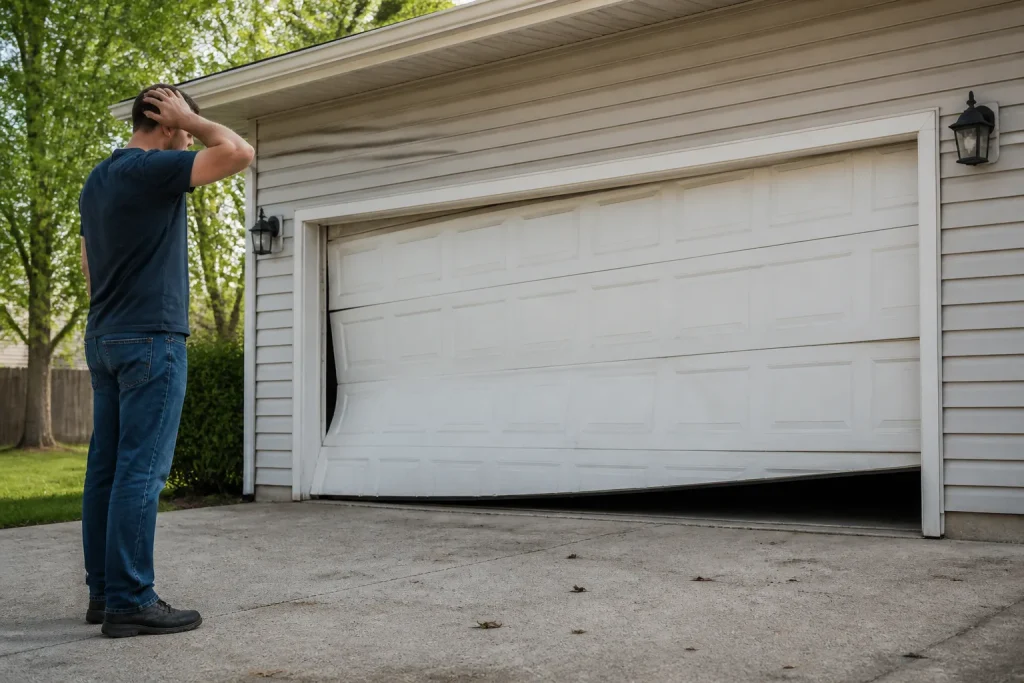
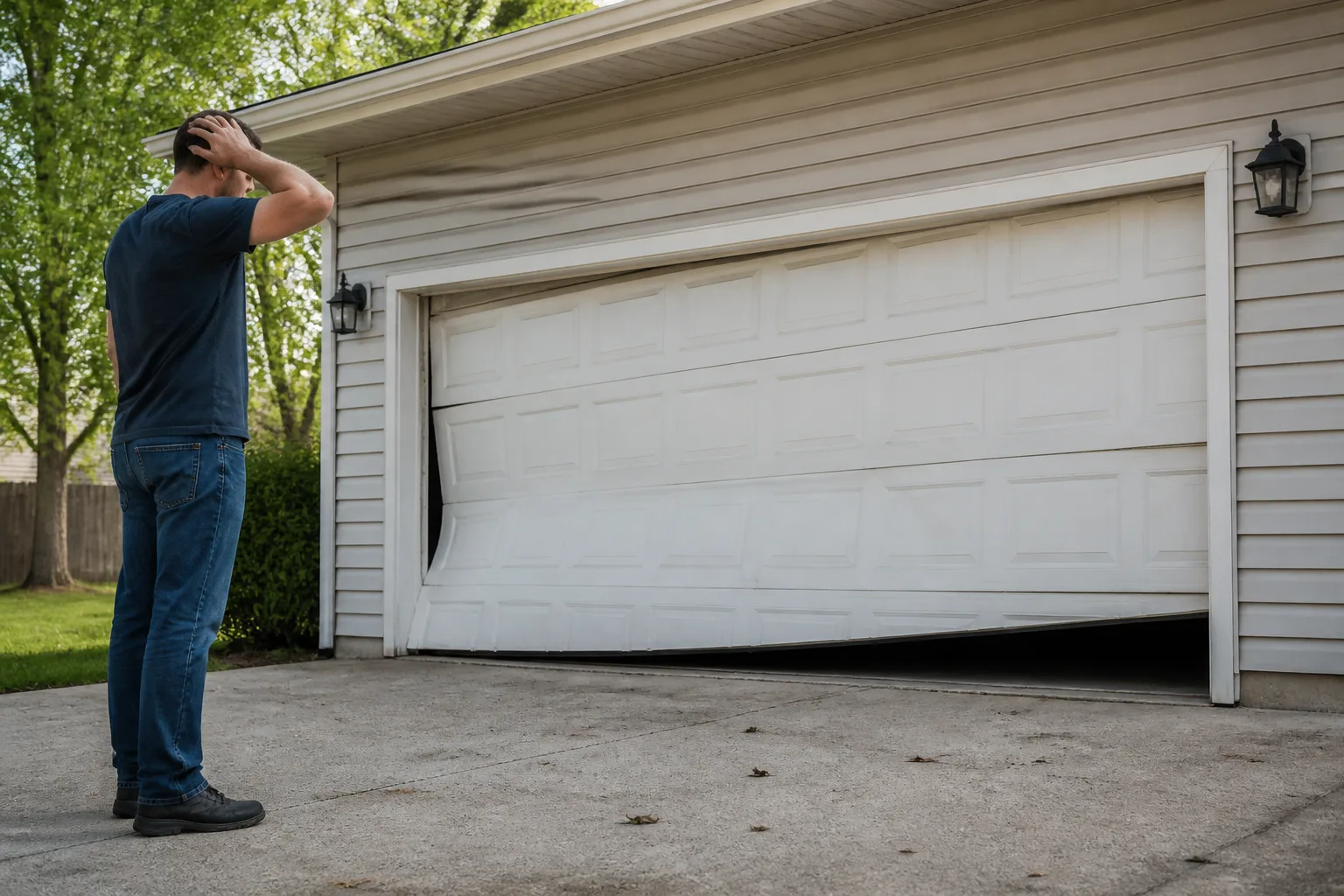
Top Signs You Need Garage Door Service – Don’t Ignore These
A garage door that takes two seconds longer to open than it did six months ago isn’t “getting old” – it’s a torsion spring that has lost wind cycles and is now making your opener motor work outside its rated torque range, shortening its lifespan with every use. That’s the thing most homeowners miss: what looks like a small quirk is a specific mechanical signal pointing at a specific worn component. Read those signals correctly and you pay for an adjustment. Read them late and you pay for cables, panels, and an opener. We work on garage doors only, so we see how these stories usually end. If you’d rather not diagnose it yourself, call (866) 809-2029. We answer 24/7. Fast dispatch from 7am to 7pm, Sunday through Friday.
What do the early warning signs of a failing garage door actually mean?
Most early warning signs are component-specific, not cosmetic. A door that reverses more slowly, a bottom edge that sits crooked, a grinding note that wasn’t there before – each one maps to a part under load, and each one gets more expensive the longer it runs. Here’s how the common symptoms translate:
- Slow travel or a sluggish start: torsion spring tension loss. The spring is supposed to carry most of the door’s weight, so when it weakens the opener picks up the slack and strains.
- Grinding when the door reverses: worn steel rollers or a track that has shifted out of alignment.
- An uneven gap along the floor: a broken or slack cable on one side, letting that corner drop.
- Loud operation: dry or damaged rollers, usually, not the opener. Homeowners blame the motor first and the rollers last.
- A single loud bang from the garage: a torsion spring snapping. Stop using the door and call a specialist.
None of these are quirks. They’re the door telling you which part is tired. Catching them early is what keeps a repair from turning into a replacement.
How do you run the balance test to check spring health in Southampton?
The balance test is the simplest spring diagnostic a Southampton homeowner can run, and it takes about a minute. Close the door, pull the red manual release cord to disconnect the opener, then lift the door by hand to roughly halfway and let go. A healthy door holds its position – or drifts slowly and evenly. A door that sags to the floor or shoots back up has lost spring tension, and the opener has been carrying weight it was never rated to carry. A balanced door also lifts with two fingers; if you’re leaning into it, the springs are done.
Reconnect the opener before using the door again, and run the test no more than a couple of times – each cycle adds wear. Don’t repeat this test if the door travels roughly or you hear scraping; that points to a cable or roller problem the test won’t fix. This check tells you whether the springs are healthy, not how to adjust them. Spring work is high-tension work, and it requires a specialist.
What should you look for when inspecting garage door cables?
Cables fail in patterns, and each pattern tells you how close you are to a failure. With the door closed, look along the cables on both sides – you’ll find them running up to the drums at the top corners. Three things stand out:
- Fraying. A healthy cable is a tight, smooth braid. Broken strands that stick out like a brush, or a cable that looks flattened or birdcaged in one spot, mean it’s time to replace it.
- Rust oxidation on the lower cable drum. Orange or brown dust around the drum is corrosion eating into the winding surface, and it weakens the cable right where it takes the most load.
- One-coil unwrap on the drum. The cable should be wound snugly. A single loop sitting loose or riding up over the edge of the drum means failure is imminent – stop using the door.
Cables are always under tension, and a snapped cable can whip. If you spot any of these, don’t try to fix it yourself. Book garage door repair and let a technician handle it.
Why does your door stop and reverse? The sensor symptom most homeowners misread
A door that closes partway, then reverses back up is almost never an opener problem – it’s usually the safety sensors at the bottom of the tracks. Homeowners replace openers when the fix was two dirty lenses. Before you call anyone, wipe the sensor eyes on both sides and make sure nothing’s blocking the beam. Then check the small LED on each sensor: on most brands a steady light means it’s fine, and a flashing or off light means the sensor isn’t seeing the other one. Craftsman and LiftMaster units often use the same pattern, while some older Genie openers blink a code on the main motor housing instead – count the blinks and look up that brand’s code list. If the sensors are clean and aligned and the door still reverses, the problem is behind the panel. We handle garage door opener repair on these systems every week.
Why is one broken spring on a two-spring door a safety issue, not an annoyance?
On a two-spring system, the springs share the load evenly – and when one breaks, the survivor takes on all of it. That door is now carrying twice its designed load on the remaining spring, its cables and its opener. It’s a structural risk, not an inconvenience. The second spring often fails soon after, the door can drop unevenly, and your opener is pushing against a load it was never rated for. A broken spring also means the door is no longer safe to lift by hand.
Spring repair is high-tension work – it requires a specialist, not a general handyman, because the springs store enough force to cause serious injury if released without the right winding bars and technique. If the door is stuck open, unplug the opener if you can reach the cord safely and leave the door alone. When you call, a technician will confirm the spring’s condition and quote the repair before starting work. We can work with your insurer if a snapped spring or dropped door has caused related damage.
When should you call a pro instead of waiting?
Call now if a spring has snapped, a cable is frayed or loose on the drum, the door is sitting crooked, the opener is straining or smoking, or the door reverses on its own after you’ve cleaned the sensors. Those are the signs that can turn from a repair into damage to your panels, opener and tracks. For anything cheaper to fix early – worn rollers, a sticky track, loud operation – a proper diagnostic stops the wear from spreading. In our experience, reading the symptom early is what keeps it a small job. When it’s time, call (866) 809-2029 for a free estimate. Our technicians have up to 14 years of experience across brands like Clopay, Amarr, Wayne Dalton and Craftsman, and we specialize in garage doors only.
Related services in Southampton: garage door repair for the symptoms above, garage door opener repair if the opener is the culprit, and garage door installation when the door is past saving. You can also browse Southampton Garage Door Repair Pros for the full picture.
The Bottom Line
Treat the small signs as specific signals, not age. A slow door, a grinding reverse, an uneven bottom gap and a single bang each point at a component that’s already under strain. The balance test tells you about spring health in a minute, a cable inspection tells you how close you are to a failure, and cleaning the sensor eyes saves you a needless opener replacement. Catch them early and you’re paying for an adjustment. Wait, and the repair grows to cables, panels and opener. If you’re in Southampton and need help, Southampton Garage Door Repair Pros offers free estimates – call (866) 809-2029. We answer 24/7. Fast dispatch from 7am to 7pm, Sunday through Friday.
Frequently Asked Questions
A tune-up covers a door that works but is getting noisy or stiff: worn rollers, a dry track, a minor adjustment. Service is needed when the door is reversing on its own, sitting crooked, or a spring has snapped – those are safety issues, not maintenance. If the balance test fails or you spot a frayed cable, it’s service.
A weak spring makes the door feel heavy and drift down when you lift it halfway. A broken spring stops carrying the load entirely – you’ll often have heard a loud bang, and the door won’t stay up on its own. Stop using the door either way and have it checked by a specialist.
Simple things like cleaning the sensors, wiping the track and checking for obstructions are fine. Springs and cables are high-tension parts and should only be handled by a trained technician, because releasing that stored force without proper tools can cause serious injury.
The price depends on the part – a spring, a cable, a set of rollers or an opener component – and the estimate is set per job by the written quote, with free estimates. Call (866) 809-2029 for an exact quote – estimates are free.
Written by the team at Southampton Garage Door Repair Pros.
Need Garage Door Help?
Call Southampton Garage Door Repair Pros - the local pro we connect you with is licensed and insured, here with fast help in Southampton.
(866) 809-2029